---
title: "How to Measure Influencer Marketing ROI: A 5-Step Framework"
description: "How to measure influencer marketing ROI: set the goal, pick the right creators, track the metrics that matter and prove ROI beyond social media."
image: https://opensponsorship.com/hubfs/2026-influencer-roi-report.png
---
[](https://opensponsorship.com/)
[Case Studies](https://learnmore.opensponsorship.com/case-studies)
[Create Free Account](https://opensponsorship.com/registration?type=brand&utm_source=Blog+header&utm_medium=Blog+header&utm_campaign=Blog+header&utm_id=Blog+header&utm_term=Blog+header&utm_content=Blog+header)
# How to Measure Influencer Marketing ROI: A 5-Step Framework
- [Home](https://opensponsorship.com/)
- Blog Details
[Ishveen Jolly](https://opensponsorship.com/blog/author/ishveen-jolly) October 28 2026
How do you measure influencer marketing ROI when half the numbers social media gives you are vanity metrics? It is the question brands ask us most, and it came up again when I joined Massimo Marinelli on the [Berkida Ventures Podcast](https://youtu.be/B4ZbTuptLYU). After more than ten years and thousands of brand deals with athletes and creators at OpenSponsorship, here is how we think about it, and the framework we use with our clients.
The short version: social media is a blessing and a curse. You get more numbers back than ever before, but sales are the holy grail. The job is to connect the two, and it starts before a single post goes live.
## Why is influencer marketing ROI so hard to measure?
Sponsorship used to be very archaic. It was a world of "who do you know", with very little strategy and very little data. A big company would have a sponsorship team in one office signing large contracts, and a marketing team down the hall justifying every single dollar. The sponsorship side rarely had to prove sales, and the marketing side rarely got to use the assets.
Influencer marketing inherited some of that. Brands still book creators on follower counts, count likes at the end, and call it a campaign report. Three things make ROI tricky:
1. **Attribution is messy.** Someone sees a post on Tuesday, searches for the brand on Friday and buys on Sunday. The creator did the work, but last-click reporting gives the credit to search.
2. **Every campaign has a different goal.** A campaign built to generate content should be judged on the content. A campaign built to drive sales should be judged on sales. Mixing them up is how good campaigns get labeled as failures.
3. **Surface metrics are easy to inflate.** Views and likes are useful, and they are also the easiest numbers to game with fake followers or a lucky post.
The good news is that every one of these is solvable with some planning up front.
## Step 1: What is the goal of your campaign?
Before we pick a single athlete or creator, we ask one question: what are you trying to achieve? For nearly every brand, the answer falls into one of two buckets.
**1. Content.** Roughly 30% of our deals are really about content. The brand wants great photos and videos (often called UGC, user-generated content) to use in its own ads, website, emails and social channels. Here, what you care about is the quality of the content, how fast it arrives, how accurate it is to the brief and the cost per usable asset.
**2. Awareness or sales.** The other 70% or so are trying to drive something: brand awareness, sign-ups, store visits or sales. Here the creator's audience matters as much as their content, and the metrics shift toward reach, engagement quality and conversions.
Write the goal down, agree on it internally, and pick your ROI metrics from it. Everything else in this guide flows from that one decision.
## Step 2: How do you pick creators who will deliver ROI?
ROI is decided at the selection stage more than anywhere else. When the goal is awareness or sales, we look at four things for every athlete or creator:
1. **Authenticity.** Will this audience respond to what the brand is offering? Does this person already talk about the topic, or something close to it? A runner who already posts about recovery will sell a sleep product more naturally than a bigger name who has never mentioned it.
2. **Following.** Audience size is a bit of a vanity metric, but it does make a difference to reach, so it belongs in the mix.
3. **Engagement rate.** When they post, does their audience respond? Engagement is also a good proxy for spotting fake followers.
4. **Audience demographics.** Is the following male or female? What age? Which country and which state? We use audience data to check that the people watching are the people the brand wants to reach.
You are essentially trying to predict whether a post will do well before it goes out into the world. The more of these boxes a creator ticks, the better your odds.
One more thing we have learned: the best campaigns are a mix of personalities. Very rarely does a campaign need only athletes. Look at the Super Bowl, where the biggest brands line up an athlete, a rapper, an actor, a content creator and a gamer. On a smaller budget the same idea works: a couple of athletes alongside recipe creators, wellness experts, parents or podcasters will usually outperform a single type of voice.
## Step 3: Why does the creative matter as much as the creator?
Traditionally there were two kinds of sponsorship. You spent a million dollars on a superstar and brought in an agency for photo shoots and billboards. Or you spent far less, had an athlete turn up to an event, and barely thought about the creative at all.
Our view is that even if your deal is $5K, you should think about the creative: the Instagram post, the story, the caption. All of it needs rigor. We treat a $10K deal with the same care as a million-dollar deal, because the creative is where ROI is won or lost. The same creator can drive very different results depending on the hook in the first second, whether the product feels natural in the video and whether there is a clear reason to act.
Practical checks before anything goes live:
- Does the brief give the creator room to sound like themselves?
- Is the product shown in use, in a natural moment from the creator's day?
- Is there a trackable action: a discount code, a link or a landing page?
- Have you agreed usage rights so you can reuse the content in ads and email?
## Step 4: Which metrics should you track?
This is where most reports go wrong. Views and likes are a starting point. Here is what we look at, roughly from weakest to strongest signal:
### Views, reach and likes
Useful for awareness campaigns and for comparing creators against each other. On their own, they say very little about intent.
### Engagement rate
Engagement divided by reach tells you whether the content connected. Always calculate it the same way across creators, otherwise you end up comparing apples with oranges.
### Saves and shares
Social platforms now report saves and shares, and we love these metrics. If a new clothing line gets saved a thousand times, that is a strong intent signal. That person may not buy today, but they have put it on their wish list. Saves and shares move measurement away from views and likes toward something much closer to purchase intent.
### Cost per view and cost per engagement
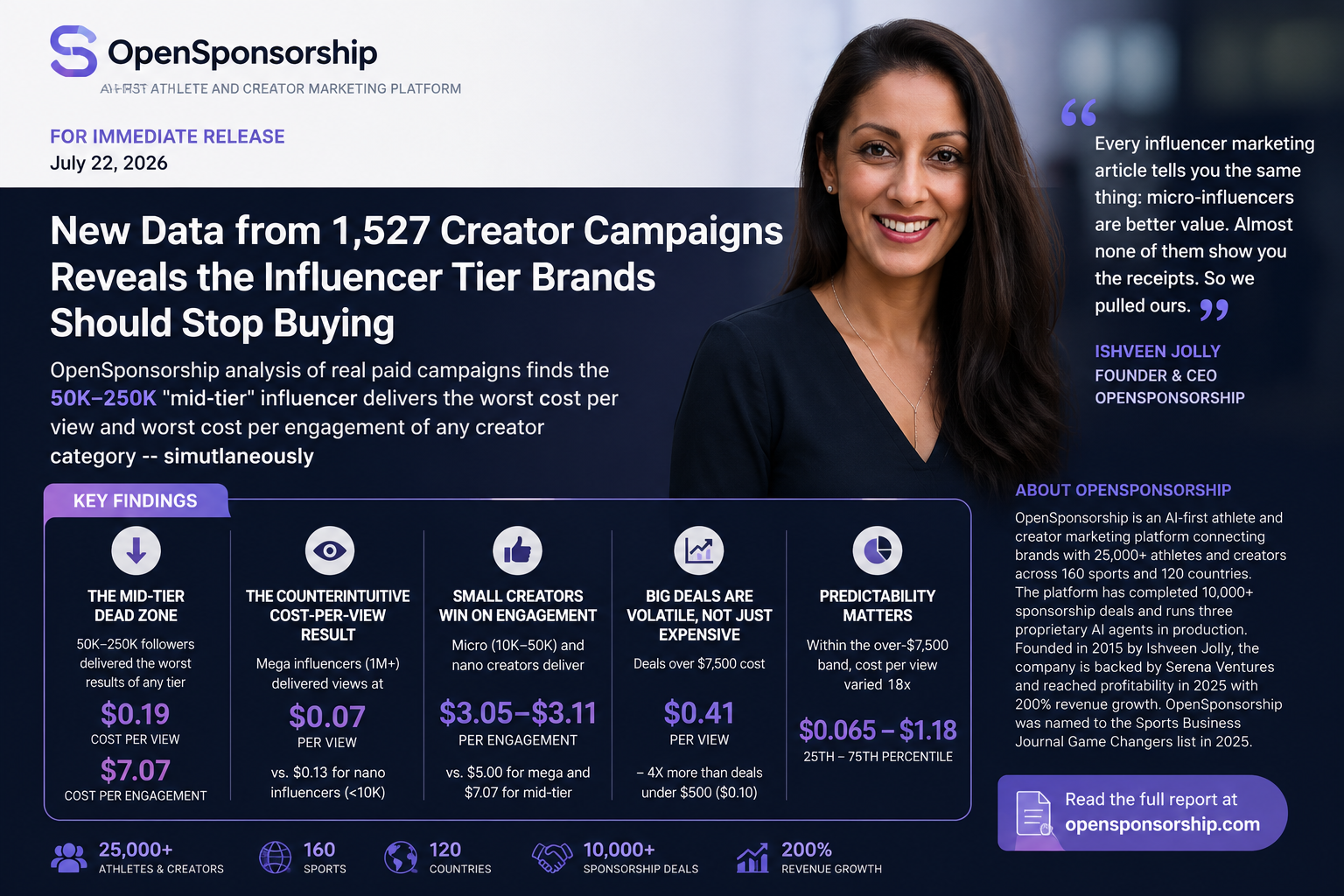
Divide what you paid by the result. This is how you compare a large creator against five smaller ones on a like-for-like basis. As one example, a campaign we ran for Immunotec with track athlete J'zotta Rolle returned 226,360 views at less than a cent per view.
### Conversions: codes, links and sales
Give every creator their own discount code or tracked link. That way each sale traces back to the creator who drove it, and you know exactly who to book again. This is the closest thing influencer marketing has to a clean sales number.
## Step 5: How do you prove ROI beyond social media?
The brands that see the biggest return from creators use them across their whole marketing team. Say you sign a deal with a goalkeeper who is trending during the World Cup. That content should then go to your paid media team, your PR agency, your email team and even your connected TV. Every channel should have a piece of the creator in it. For one financial services client, a creator video we produced was run on connected TV and outperformed all of their other creative.
That is also where the strongest proof of ROI comes from:
1. **Paid ads.** Some of our best results have come from clients telling us that when they used athlete or creator content in their paid ads, it drove more sales than their own generic brand content. Run it as an A/B test and you can show a lower cost of acquiring a customer (CAC) with creator content. That is a number any CFO understands.
2. **Email marketing.** Test creator content against your usual creative in email. Subject lines, click-through rates and conversion rates will tell you quickly whether it performs better.
3. **B2B and events.** For business audiences the question is often: do better quality people show up? When you send out content featuring a well-known athlete, do more senior decision-makers open it, click it or register?
If your tracking is still early, start with engagement, saves, shares and codes, and build toward sales attribution over time.
## What does a good influencer marketing ROI report include?
At the end of every campaign, a useful report should answer five questions in plain English:
1. What was the goal, and did we hit it?
2. Which creators performed best on the metric that matters for that goal?
3. What did it cost per result (per view, per engagement, per sale)?
4. Which pieces of content should we put paid media behind?
5. Who should we book again, and what should we change next time?
A report that answers those five questions is one your leadership team will read, and it makes the next budget conversation a lot easier.
## Why do female athletes deliver such strong value?
One of the clearest ROI trends we have seen is the rise of female athletes. Two years ago women overtook men on our platform by number of deals, and in 2025 roughly 70% of our deals were with women. Track and field is our top women's sport by deal volume.
There are a few reasons. Many female athletes are more affordable than their male counterparts, which is good news when you focus on value. Many are also naturally great content creators who share their training, their families and their daily routines. Brands often choose a female athlete because they like her voice and what she talks about, and the sport itself comes second. That makes it much easier to find a natural fit for wellness, beauty, food and lifestyle brands.
## Can AI measure influencer marketing ROI for you?
AI is scary and helpful at the same time. You can ask an AI tool which creators to work with and get ten names in seconds. The harder questions are what to pay them, what to ask for in the deal, how to negotiate it and how to run it, and that is where experienced people make the difference. AI can solve little bits of the process, and it can also create more headaches across the whole process.
We use AI across our own product for discovery and analysis, and we pair it with people who have negotiated and run thousands of deals. That combination is where the value is.
## Watch the full conversation
I covered all of this and more, including how we started OpenSponsorship, what I learned going through the 500 Startups accelerator and where I think athlete and creator marketing goes next, in the full episode:
Thank you to Massimo Marinelli and the Berkida Ventures team for having me.
## Frequently asked questions
### What is a good ROI for influencer marketing?
It depends entirely on the goal. For content campaigns, measure cost per usable asset against what the same content would cost from a production agency. For sales campaigns, compare the cost of acquiring a customer through creators against your other channels. Set the benchmark before the campaign starts, so you have something to measure against.
### How do you calculate influencer marketing ROI?
The simplest formula is revenue attributed to the campaign, minus the campaign cost, divided by the campaign cost. Use creator-specific discount codes and tracked links to attribute the revenue, and include all costs: creator fees, product, agency fees and any paid media behind the content. For benchmarks, see our [influencer marketing ROI guide](https://opensponsorship.com/knowledge/influencer-marketing-roi).
### Which metrics matter most in influencer marketing?
For awareness: reach, engagement rate, saves and shares. For sales: conversions from codes and links, cost per acquisition and the performance of creator content in your paid ads. Saves and shares are the most underrated because they signal purchase intent.
### How much does influencer marketing cost?
It ranges widely, from a few hundred dollars a post for micro athletes and creators to six figures for household names. See our guide to [athlete sponsorship costs in 2026](https://opensponsorship.com/blog/how-much-does-athlete-sponsorship-cost) for pricing by follower tier.
### Are athletes or creators better for ROI?
Usually a mix of both. Athletes bring credibility and fans who follow them all year round. Creators bring consistent content skills and niche audiences. The strongest campaigns we run combine both types of voices.
### How long does it take to see ROI from influencer marketing?
Engagement data arrives within days of a post going live. Sales from codes and links usually build over two to four weeks, and the extra value from reusing creator content in paid ads and email can keep paying back for months.
## Want help measuring your next campaign?
OpenSponsorship is an end-to-end tech-enabled agency that has matched brands with athletes and creators since 2014. We handle the whole process: picking the right people, negotiating fair prices, building the creative and tracking the ROI. Tell us your brand and who you want to reach, and we will [send you five creators who fit](https://opensponsorship.com/learn-more/creator-shortlist). Or [book a call with our team](https://meetings.hubspot.com/ishveen/marketing-emails-2025).

#### [Ishveen Jolly](https://opensponsorship.com/blog/author/ishveen-jolly)
Ishveen, a former sports agent, is the CEO and Founder of OpenSponsorship, which she started from her love of all things marketing, sponsorship, data, efficiency and creativity. She hopes we can power your next influencer marketing campaign. She was recognized on the Forbes 30Under30 list, Inc's top 100 female founders, Advertising Week future is female.
#### Popular Post
#### [How to Measure Influencer Marketing ROI: A 5-Step Framework](https://opensponsorship.com/blog/how-to-measure-influencer-marketing-roi-1)
October 28, 2026
#### [How Genisys Credit Union Built a Multi-Year Detroit Lions Athlete Program](https://opensponsorship.com/blog/genisys-credit-union-detroit-lions-athlete-sponsorship)
October 06, 2026
#### [Nano vs Micro vs Mega Influencers: What 1,527 Creator Campaigns Reveal About Cost and ROI](https://opensponsorship.com/blog/nano-micro-mega-influencer-pricing-data)
July 15, 2026
#### [Ingredient Branding Done Right: How Immunotec Made Glutathione Mainstream](https://opensponsorship.com/blog/ingredient-branding-glutathione)
July 13, 2026
#### [America's 250th Birthday: The Brand Activation Playbook for 2026](https://opensponsorship.com/blog/america-250-brand-activation-playbook)
July 01, 2026
#### Tag Cloud
[marketing](https://opensponsorship.com/blog/tag/marketing) [sponsorship](https://opensponsorship.com/blog/tag/sponsorship) [athletes](https://opensponsorship.com/blog/tag/athletes) [Uncategorized](https://opensponsorship.com/blog/tag/uncategorized) [sports](https://opensponsorship.com/blog/tag/sports) [Brand Endorsements](https://opensponsorship.com/blog/tag/brand-endorsements) [sports marketing](https://opensponsorship.com/blog/tag/sports-marketing) [Parterships](https://opensponsorship.com/blog/tag/parterships) [Endorsement](https://opensponsorship.com/blog/tag/endorsement) [athlete marketing](https://opensponsorship.com/blog/tag/athlete-marketing) [brand ambassador](https://opensponsorship.com/blog/tag/brand-ambassador) [influencer marketing](https://opensponsorship.com/blog/tag/influencer-marketing) [sports brands](https://opensponsorship.com/blog/tag/sports-brands) [endorsements](https://opensponsorship.com/blog/tag/endorsements) [NIL](https://opensponsorship.com/blog/tag/nil) [olympics](https://opensponsorship.com/blog/tag/olympics) [Fitness](https://opensponsorship.com/blog/tag/fitness) [sports innovation](https://opensponsorship.com/blog/tag/sports-innovation) [artificial intelligence](https://opensponsorship.com/blog/tag/artificial-intelligence) [social media](https://opensponsorship.com/blog/tag/social-media) [NFL](https://opensponsorship.com/blog/tag/nfl) [nba](https://opensponsorship.com/blog/tag/nba) [KPIs](https://opensponsorship.com/blog/tag/kpis) [mlb](https://opensponsorship.com/blog/tag/mlb) [nhl](https://opensponsorship.com/blog/tag/nhl) [twitch](https://opensponsorship.com/blog/tag/twitch)
### OpenSponsorship Blog
## FAQs
What is OpenSponsorship?
OpenSponsorship is an online marketplace and platform that connects athletes, teams, and influencers with brands and businesses for sponsorship opportunities. It was founded in 2014 and has since become one of the leading platforms in the sports sponsorship industry.
How do I signup as a brand?
Brands can signup for free here: https://opensponsorship.com/registration?type=brand
How do I signup as an athlete?
Athlete can signup for free here: https://opensponsorship.com/registration?type=athlete
```json
{
"@context" : "https://schema.org",
"@type" : "BlogPosting",
"author" : {
"@type" : "Person",
"name" : "Ishveen Jolly",
"url" : "https://opensponsorship.com/blog/author/ishveen-jolly"
},
"dateModified" : "2026-10-28T20:55:05.942Z",
"datePublished" : "2026-10-28T20:54:50.000Z",
"headline" : "How to Measure Influencer Marketing ROI: A 5-Step Framework",
"mainEntityOfPage" : {
"@id" : "https://opensponsorship.com/blog/how-to-measure-influencer-marketing-roi-1",
"@type" : "WebPage"
},
"publisher" : {
"@type" : "Organization",
"logo" : {
"@type" : "ImageObject",
"url" : "https://opensponsorship.com/hubfs/OpenSponsorship_logo_compact-3.png"
},
"name" : "Opensponsorship"
}
}
```